FSRS v6 in Reme: porting a memory model to a study app
Reme is the spaced-repetition app I built for my own exam preparation (Chinese postgraduate entrance exam, politics question bank). Its scheduler is a from-scratch Dart port of FSRS v6.1.1 — the open-source algorithm that has been beating Anki’s classic SM-2 in benchmark after benchmark. This note documents what the algorithm actually computes, how the port is verified against the reference implementation, and the two places where I deliberately deviate from it.
The memory model
FSRS models each card’s memory as three numbers:
- R (retrievability) — the probability you can recall the card right now. Starts at 1 after a review and decays.
- S (stability) — how many days it takes for R to fall from 1.0 to 0.9. Higher stability = slower forgetting.
- D (difficulty) — a 1–10 scale describing how hard the card is for you. Difficulty changes slowly; stability is where all the action is.
The decay is a power law, not SM-2’s fixed interval multiplier:
with requestRetention fixed at 0.9 by default. The whole curve family
is one function parameterized by S — that is the model’s central idea:
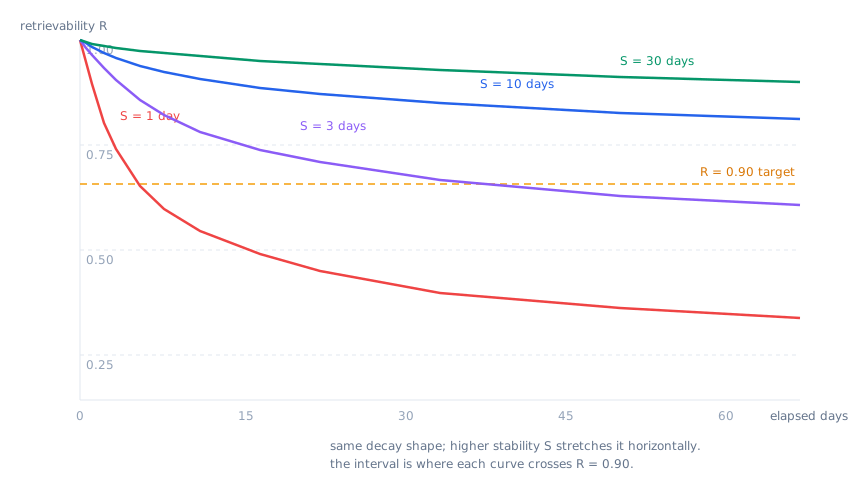
The next review interval is defined as where the curve crosses R = 0.90, inverted algebraically:
So “stability” is not an abstraction — it is literally the number of days until recall probability drops to your target retention.
The update rules
Every rating updates D and S through closed-form formulas driven by 21
weights (w[0]…w[20], shipped as defaults, optimizable per-user later).
Difficulty moves by a rating-dependent step, damped near the ceiling, then pulled toward a mean-reversion anchor:
where g is the rating index (1=Again … 4=Easy). The damping term
(10 − D)/9 slows increases as difficulty approaches 10, so a card can
stay hard without becoming impossible.
Stability after successful recall multiplies the old stability by a growth factor depending on difficulty, current stability, elapsed-time retrievability, and the rating:
Three properties fall out of this formula, and they are what make FSRS behave sensibly:
(11 − D)— easy cards grow stability faster than hard ones;S^(-w9)— growth is multiplicative but decelerating, so intervals stretch rather than explode;(e^((1−R)w10) − 1)— reviewing early (high R) barely helps; reviewing at the point of nearly forgetting (low R) is what builds stability. The algorithm prices in desirable difficulty.
Stability after a lapse is computed by a separate formula and capped at a floor proportional to the old stability:
A forgotten card does not reset to zero — it keeps some fraction of its stability, so relearning is faster than first learning. That matches the empirical “savings” effect from the memory literature.
What this looks like in practice
Running the actual weights used in Reme, a new card rated Good on every review evolves like this:
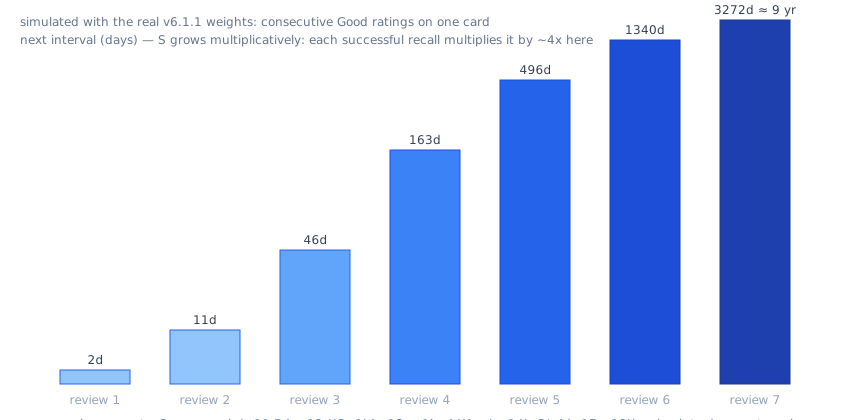
2 days → 11 → 46 → 163 → 496 → 1340 → 3272 (about nine years). Seven successful reviews take a card effectively out of rotation. A single Again, though, collapses stability back to days — the asymmetry between the recall and lapse formulas is the entire behavioral profile of the algorithm.
Verifying a from-scratch port
Porting numeric code is easy; knowing the port is right is the hard part. Two mechanisms in Reme handle this:
- Golden-value tests. A small JS script runs the official
fsrs4anki_scheduler.jsv6.1.1 pure functions and dumps expected D/S/R values intofsrs_golden_test.dart. The Dart port must match them to ±0.01. Example cases: a new card rated Again must produce D=6.41, S=0.21; a review-state card with D=3, S=3 after exactly 1 day must compute retrievability R=0.957336. - Deterministic fuzz seeds. FSRS applies a ±5% random “fuzz” to
intervals so many cards due the same day spread out. Instead of a
global RNG, Reme hashes the question ID into a per-card seed
(
seed = h(questionId)), so the fuzz is deterministic: the same card always gets the same offset, and test expectations never flake.
Interval ordering is also enforced as a post-condition: after computing all four outcomes, the scheduler clamps Hard ≤ Good ≤ Easy with strictly increasing steps. This guards against edge cases where the raw formulas produce inverted intervals for extreme states.
Two deliberate departures
The port follows the reference implementation numerically, but the app layer deviates in two places, both tuned for exam prep rather than lifelong knowledge:
1. First-pass mastery at 25 days. In standard FSRS, a new card rated Good gets whatever the initial stability formula says (about 2 days with default weights). But a multiple-choice politics question answered correctly on the first encounter is qualitatively different from one that survived a review cycle: either you know it or you guessed well. Reme schedules first-attempt correct answers straight to S = 25 days (13 for a hesitant “Hard”), skipping the short-interval churn. Wrong-on- first-attempt cards go through normal FSRS scheduling with in-session repetition until mastered.
2. Daily quota instead of infinite queue. Classic SRS wisdom says
“reviews are always due-first and never truncated.” For a student with a
syllabus and a deadline, that advice produces backlogs that kill
motivation. Reme introduces new questions under a daily cap
(new_daily_cap) inside a daily target, so workload stays flat even
when hundreds of cards come due after a break. Due reviews still come
first; the cap governs only new-card introduction.
Both deviations are visible in the review log (events tagged
scheduled_review vs session_practice), which matters for the next
step.
Open problems
- Personal optimization. The 21 weights ship as population defaults. FSRS ships an optimizer that fits them to your own review log once you have enough data. My review ledger already records before/after state per event, so running the optimizer on my own data is a planned step — and worth a follow-up post when there are enough samples.
- First-pass mastery vs. the optimizer. The 25-day override injects synthetic stability values the optimizer will see as outliers. Reconciling the custom policy with data-driven weight fitting is an open design question.
- Exam-date awareness. The scheduler optimizes long-term retention; an exam on a fixed date should shift the target retention upward as the date approaches. Not implemented yet.