Building the Kernel-Level Location Forger: A Design Blueprint
this is the implementation companion to the previous post on modeling kernel-level GNSS forgery. that one asked why it works; this one is how to build it. the blueprint: a KernelSU-style GKI kernel module written in Rust, hooking the GNSS driver’s output, controlled by an app through a device node.
the shape of the system
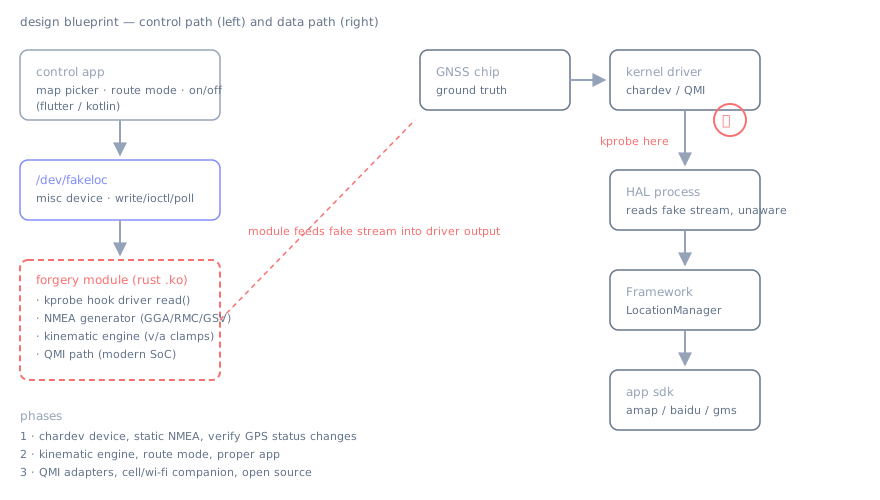
two paths, one module:
- control path: app →
/dev/fakeloc→ module (set coordinates, mode) - data path: module → driver output → HAL → Framework → SDK
everything above the hook point sees a self-consistent fake world, because the fake data is born below all of them.
component 1: the kernel module (KernelSU mechanics)
nothing new needs inventing here — KernelSU proved the whole chain:
- load: unlocked bootloader →
insmodthe GKI module (signed with a test key, exactly the KernelSU arrangement) - hook:
kprobe, the dynamic instrumentation mechanism that can hook any kernel symbol regardless of the GKI KMI surface — this is precisely why KernelSU works on stock GKI kernels - lifecycle:
module_initregisters the kprobe and the device node;module_exitcleans both up
component 2: the forgery point, by platform
chardev SoCs (legacy Qualcomm / MediaTek) — the easy path:
the GNSS chip is exposed as a character device (/dev/gnss,
/dev/ttyMT*). kprobe the driver’s file_operations.read, and answer
every HAL read with generated NMEA instead of driver data:
GPGGA— position, satellite count, HDOPGPRMC— speed, true course, UTC time, lock stateGPGSV— satellite sky distribution
the three must agree with each other: if GPGGA says 8 satellites and HDOP 1.2, GPGSV better list plausible satellites and GPRMC better give consistent speed. the HAL parses whatever it reads; it never knows the chip didn’t say it.
QMI SoCs (modern Snapdragon, SM8350+) — the real work:
GNSS lives inside the modem; data arrives as QMI_LOC messages. the hook moves into the QMI driver stack (message dispatch), and you forge position messages instead of NMEA sentences. more complex — message formats, transaction IDs — but same principle: the HAL reads what you put there.
component 3: the kinematic engine (inside the kernel)
teleporting is what gets user-space tools caught. the module runs a tiny trajectory generator so the fake position moves like a body:
state: p, v, a
every tick (dt):
    a ← clamp(activity_sample(), ±a_max)     # walk 1.5, drive 30 m/s
    v ← clamp(v + a·dt, ±v_max)
    p ← p + v·dt
    if ‖p − anchor‖ > radius: v ← −v         # hover near target
velocity and acceleration limits are detection thresholds — keep the fake inside them and motion-plausibility checks pass by construction. the same engine feeds speed and heading into GPRMC, keeping NMEA internally consistent. this is where rust earns its keep: no GC pauses, no lock contention, tight numeric loops.
component 4: the control channel
- module registers a misc device →
/dev/fakeloc - app → kernel:
write()structured commands (coordinates, mode, enable),ioctl()for status - kernel → app:
poll()wakeups when module state changes - permissions: node owned
root:system, app accesses via root granted by KernelSU; SELinux gets a small policy addition (KernelSU ships the pattern)
component 5: why Rust
- the
kernelcrate is stable and shared by all in-tree Rust code; the Android binder driver was rewritten in Rust and landed in mainline 6.18 — the platform is committed to this path - a kernel module crash is a full reboot; Rust turns the memory-safety bug class into compile errors. for a module touching drivers and device nodes, that’s the difference between a project and a hobby
- KernelSU itself is exploring rust modules; the ecosystem is forming
component 6: the app
flutter (or kotlin, if you want less glue): map picker to set the
target, route mode (walk a path, not a point), a master switch, and a
status readout. writes to /dev/fakeloc through plain file IO —
nothing exotic on the userspace side, which is the point: all the
magic lives in the module.
the full data flow
1. app picks (39.9042, 116.4074) → write /dev/fakeloc
2. module stores the target
3. any app requests location:
   HAL reads driver → kprobe intercepts → module emits NMEA
   (beijing, walking speed, 8 sats, hdop 1.2)
4. HAL parses → Framework → LocationManager → SDK
5. SDK's NMEA listener and raw-measurement hooks read the same
   fabricated source → consistent by construction
decisions to make, questions to answer
| decision | direction | open question |
|---|---|---|
| chardev vs QMI first | chardev, then QMI | target device’s driver path |
| NMEA self-consistency | single engine feeds all sentences | is satellite distribution ever checked? |
| time axis | forged NMEA time | compared against system clock? |
| sensor companion | static mode leaves sensors alone | does walking mode need fake steps? |
| cell/wi-fi | not forged (physical) | server cross-check remains the ceiling |
| module signing | KernelSU pattern | target bootloader state |
the mvp path
phase 1 — prove it (1–2 weeks)
  one chardev device with an unlocked bootloader
  minimal rust module: kprobe read(), inject static NMEA
  app: hardcode coordinates to /dev/fakeloc
  accept: GPS status shows the fake position; amap/baidu move

phase 2 — make it real
  kinematic engine + route mode
  proper app (map pick, switch, status)
  QMI hook for modern SoCs

phase 3 — round it out
  cell/wi-fi companion layer (LSPosed for the soft parts)
  adversarial testing against amap-class SDKs
  open source, framed for its legitimate use: validated replay
the honest risks
- the server still wins. cell/wi-fi fingerprints and position-history plausibility live beyond any client forgery — this was the conclusion of the modeling post, and it doesn’t change with better engineering.
- unlocked bootloader is a hard requirement. great for your own device, a wall for everyone else.
- QMI/SLPI adaptation is an ecosystem, not a module. expect per-SoC work.
- GKI versions move. follow the android release train or fall behind.
- defenders adapt too. kernel-integrity checks (module signatures, suspicious .ko detection) are the obvious next move for the SDKs that care.
next step
phase 1, concretely: a chardev-based device with an unlocked bootloader,
the minimal rust module hooking the driver’s read(), a static nmea
generator, and a hardcoded coordinate. the acceptance criterion is a
gps status readout showing the forged position and a consumer app
believing it. everything else in this blueprint is downstream of that
first test passing.